Driven by the surge in urban freight demand and the popularization of on-demand logistics models, the urban logistics industry has entered a period of rapid development. Diversified businesses such as same-city distribution, inter-city transportation, and corporate logistics continue to expand, bringing multiple challenges including complex capacity scheduling, dense node distribution, and increased difficulty in network collaboration.
As a leading internet logistics enterprise, since its launch, it has integrated social transportation resources through a sharing model, building an intelligent logistics network covering over 300 cities nationwide. With monthly active users exceeding 10 million, its business spans multiple scenarios such as same-city freight, inter-city transportation, and cold chain less-than-truckload shipping, ranking among the top three in global closed-loop freight Gross Transaction Value (GTV).
With the rapid business expansion and overseas market development, the enterprise’s traditional network architecture has gradually exposed performance bottlenecks and management difficulties in terms of headquarters collaboration, public cloud access, and cross-border visits.
-
Complex branch networking calls for unified management: The enterprise has laid out warehousing nodes and capacity scheduling centers in over 300 cities nationwide, resulting in a large number of branches with diverse types and a highly fragmented network architecture. Traditional networking methods struggle to meet the needs of nationwide centralized management and unified policies, leaving the headquarters without real-time visibility into the operational status of regional networks and leading to low configuration management efficiency, which restricts unified business scheduling and efficient collaboration.
-
Extensive use of public cloud resources drives growing demand for cloud migration: The enterprise’s daily operations rely heavily on cloud-based systems, with key modules such as order matching, intelligent scheduling, and customer service deployed on public cloud platforms like Alibaba Cloud. As business volume expands and scenarios diversify, data traffic becomes increasingly dense, imposing higher requirements on public cloud access quality, link stability, and security.
-
Overseas business expansion requires accelerated and guaranteed cross-border access: As the logistics enterprise gradually expands into the international market, overseas warehouses and scheduling nodes have been successively established. Some cross-border links have begun to experience issues such as high latency and packet loss, affecting overseas order scheduling, user interaction, and system interconnection. Cross-border network acceleration and compliant security have become urgent new challenges in the process of global business development.
To address the above pain points, FiberHome has tailored an Epoch SD-WAN solution for the logistics enterprise:
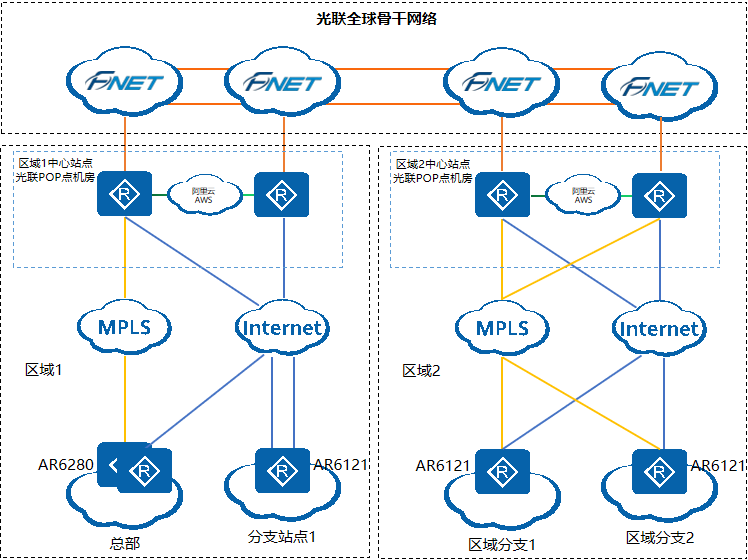
Targeting the complex management caused by the enterprise’s large number of branches and fragmented network architecture, Epoch SD-WAN devices are deployed at each site. Combined with MSTP or local internet links, the sites connect to FiberHome’s POP nodes nearby and then converge uniformly into FiberHome’s MPLS backbone network, building an end-to-end unified wide-area interconnection architecture. Through the SD-WAN control platform, centralized configuration, unified policy distribution, and real-time device status visibility are achieved, significantly improving network management efficiency.
To meet the logistics enterprise’s high-frequency access needs for core cloud-based systems such as order matching and intelligent scheduling, the FiberHome solution uses Epoch SD-WAN devices to identify cloud business traffic and perform intelligent routing. Critical data can be directly connected to Alibaba Cloud nodes through the backbone network, bypassing north-south interconnection bottlenecks and ensuring link stability and access efficiency. It also incorporates intelligent DNS protection against DNS pollution and supports SSL VPN remote access, enabling flexible cloud access for multiple roles such as scheduling centers and customer service terminals, and supporting stable system operation under high-concurrency business scenarios.
To support the enterprise’s overseas business expansion, FiberHome leverages the BGP intelligent traffic distribution capability of SD-WAN to optimize domestic and foreign traffic diversion. Overseas order systems and cross-border collaboration platforms can quickly go global through the backbone network. Combined with behavior audit devices at POP nodes, it ensures compliant and controllable overseas communications, providing high-performance, low-latency, and fully auditable network support for global logistics links.
After the solution was implemented, the logistics enterprise achieved unified access and centralized management of branch networks nationwide. Network configuration efficiency increased by 70%, and O&M response time was significantly shortened, ensuring the efficient operation of warehousing scheduling and distribution collaboration. The quality of cloud-based business access was comprehensively optimized, with the stability of key systems improved to 99.99%, supporting the high-concurrency processing of massive orders. Cross-border link latency was reduced by an average of 60%, and the access fluency of overseas nodes was greatly enhanced, effectively supporting the enterprise’s international business expansion.
In the future, FiberHome will continue to cooperate with customers, deeply integrate AI and cloud-network-security technologies around scenarios such as intelligent scheduling, global collaboration, and digital intelligent O&M, and build a more resilient and robust global logistics network foundation to help enterprises move towards a new stage of high-quality development.



 简体
简体 EN
EN