SD-WAN Deployment Avoidance Guide - Practical Strategy from Selection to Launch
May.31.2025
After the introduction of the first two issues, everyone already knows SD-WAN What is it and which scenarios is it applicable to. Many companies may have already developed a demand and want to try, but a question that comes with it is: "How should we choose SD-WAN products with so many vendors? ”
Don't worry, today we're going to talk about how businesses are making purchases SD-WAN What key points should be focused on when choosing a plan to truly achieve "usability, applicability, and cost-effectiveness" SD-WAN。 And attach a list of pitfalls to help you get it done in one go!
Stage 1: Avoiding the Trap of 'Talking on Paper'
Core issue:
On the market SD-WAN There are various solutions, some focus on multi cloud interconnection, some emphasize zero trust security, and some are purely router networking. How to choose the most suitable one for oneself?
Avoiding pitfalls guide: Demand first, don't let manufacturers dictate the pace!
Misconception: Blindly pursuing a "fully functional luxury version" results in spending more money and not being able to use it.
Correct posture: First, clarify the core demand scenario and evaluate the bandwidth requirement (such as "unified management of 500 stores" or "interconnection between headquarters building and data center"), and then compare the compatibility of vendor solutions.
Self inspection checklist:
✅ Evaluate bandwidth requirements based on actual application business scenarios?
✅ Will there be security exposure risks in the application scenario?
✅ Do you need to support multi cloud access?
✅ Business expansion plan for the next 3 years (such as adding overseas branches)
Pure hardware vs Software? Select according to the actual network environment
Pure hardware solution: suitable for environments with simple bandwidth requirements, close distances between interconnected locations, but unstable networks and high latency.
Software solution: Suitable for scenarios with dynamic changes in business requirements (such as multi location collaborative office, real-time cloud collaboration), ensuring that network latency and stability meet business sensitivity requirements.
key problem:
❓ Is the existing router/firewall compatible SD-WAN Equipment?
❓ Is it necessary to reserve an interface for the future 5 G/LTE Backup connection?
Security: Don't wait for the addition of new network exposure surfaces to regret attacks
❓ Does the manufacturer have SD-WAN Ready Service system certification?
❓ Do you have a national value-added telecommunications business license?
❓ Is it provided TL/ISO Series certificates?
❓ Can there be certification for information system security operation and maintenance services?
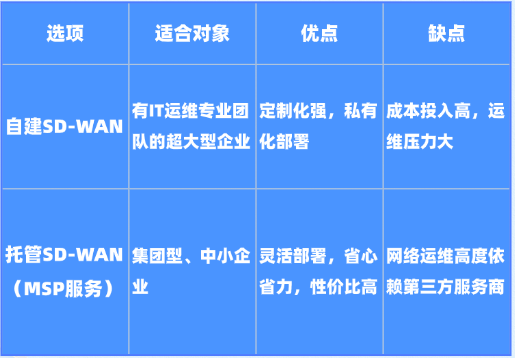
Stage 2: SD-WAN“ Which is more suitable, self built or hosted?
Enterprises are landing SD-WAN At times, there is often a choice between "self built" or "hosted".
Simple understanding:
A leading enterprise with the ability to engage in "heavy asset" activities, pursuing high customization, and possessing strong capabilities IT As a network operation and maintenance support, the team can choose to build its own team;
More emphasis is placed on "fast, cost-effective, and stable" group and small and medium-sized enterprises, which are more suitable for finding experienced service providers for hosting SD-WAN, One stop shop solution.
Stage 3: Don't ignore the testing stage, and the evaluation is reliable only by seeing the big picture from the small
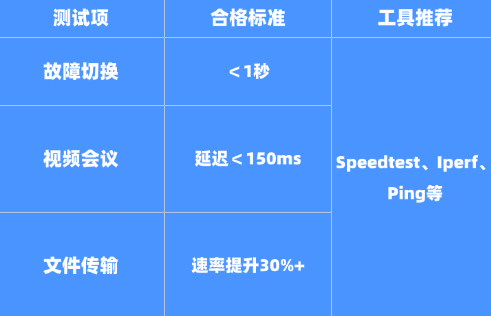
Test and verify the four step method through practical experience
1. Choose the following typical scenarios for bandwidth rate testing:
2. Key quota verification
3. Stress testing
Fully verify by simulating 200% peak traffic and initiating human connection interruption QoS The effectiveness of strategies in extreme scenarios.



 简体
简体 EN
EN